CATok
Method
Three components, one causal schedule
01
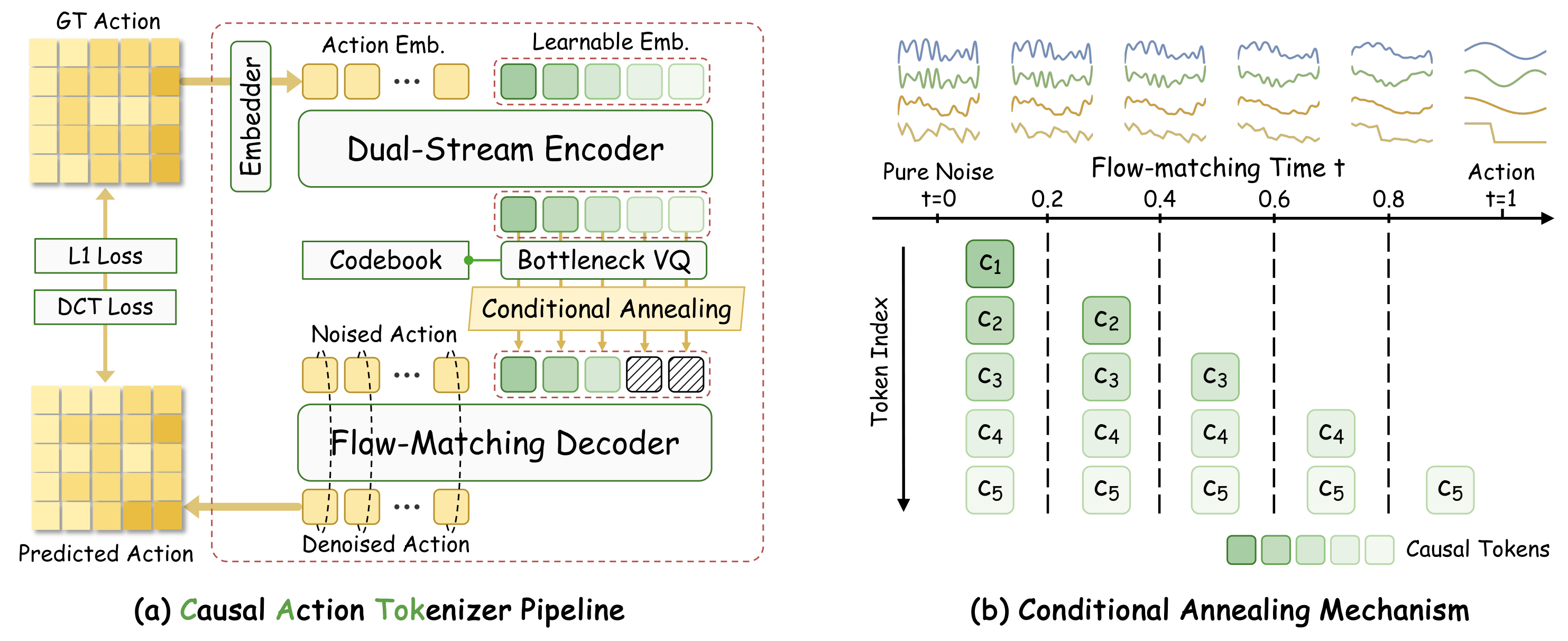
Dual-Stream Action Encoder
Maps raw action chunks into a compact set of latent query tokens via co-attention with an MMDiT-based transformer.
02
Bottleneck Vector Quantizer
Discretizes latent tokens into a finite codebook using factorized codes.
03
Flow-Matching Decoder
Reconstructs high-fidelity action trajectories with conditional annealing, enforcing a coarse-to-fine causal structure.
The key design is the conditional annealing mechanism: at flow-matching timestep t, the first ⌊tK⌋ token embeddings are progressively masked, forcing each token to specialize in a distinct generative stage—from coarse global guidance at high-noise stages to fine-grained residual corrections as the trajectory matures. This induces a causally ordered hierarchy naturally aligned with autoregressive action generation.